Blogs

Spinning risks

We've got a new animation showing all the ways we could think of for communicating a risk message. In particular, have a look what you can do when using absolute risks, expressed in natural frequencies, and using icons. The photos option is rather good, and we are planning to make it possible for anyone to put in their own examples, their own images, and embed the animation on their website.

We're nearly all at increased risk!!

Monday's headline in the Daily Telegraph: Nine in 10 people carry gene which increases chance of high blood pressure sounds shocking. Next thing they will be telling us that we are all going to die.

Does street lighting really reduce fatal road crashes by 2/3 ?

Cochrane Reviews are usually taken as the gold standard in putting the evidence together to check whether a treatment works. But a new Cochrane Review that examines how much the ‘treatment’ of putting in street lights prevents injuries and saves lives seems to suffer from some major flaws which could mean the claimed benefits from street lighting are greatly exaggerated.

Probability lessons may teach children how to weigh life’s odds and be winners

You might be interested to read this article in the Times on page 14 and an associated editorial on page 2. Also in the Times Online.

Survival back to 1845

We've added a version of our Survival animation that goes all the way back to 1845 in How long did we live?.
Can you spot the influence of the internal combustion engine in this data?

Florence Nightingale was a statistician!

Florence Nightingale is well known for her selfless nursing of the sick, and her pioneering reform of healthcare. Less well known is that she was also an accomplished statistician! We take a look at some of her finest work.

Nightingale's 'Coxcombs'

Through her work as a nurse in the Crimean War, Florence Nightingale was a pioneer in establishing the importance of sanitation in hospitals. She meticulously gathered data on relating death tolls in hospitals to cleanliness, and, because of her novel methods of communicating this data, she was also a pioneer in applied statistics. We explore the work of Nightingale, and in particular focus on her use of certain graphs which, following misreading of her work, are now commonly known as Nightingale's coxcombs.

Does it all add up?

Looks like another great talk for anyone interested in the public understanding of risk. Coming up on October 30th, by Professor Stephen Senn, as part of the Cambridge Festival of Ideas.

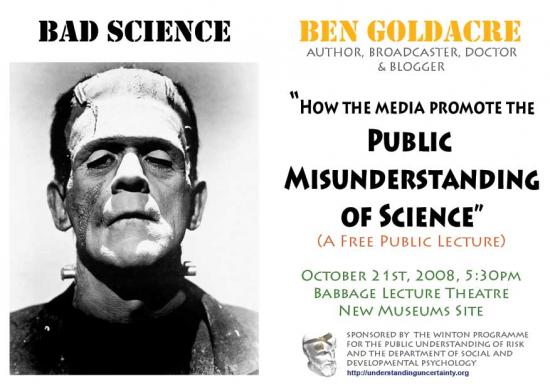
A Public Misunderstanding of Science Event

This should be entertaining and enlightening...

Ben Goldacre Poster 21st October 2008

"How the media promote the public misunderstanding of science" on Tuesday 21 October at 5.30pm in the Babbage Lecture Theatre, New Museums Site, Cambridge.

For further information on Ben's new book "Bad Science", please visit his website www.badscience.net

All are welcome to this free event, hope to see you there!

The Babbage lecture theatre is on the New Museums Site in Cambridge, which you can find here.

Pages