Egg-gate: an update
As of the 23rd May 2022 this website is archived and will receive no further updates.
understandinguncertainty.org was produced by the Winton programme for the public understanding of risk based in the Statistical Laboratory in the University of Cambridge. The aim was to help improve the way that uncertainty and risk are discussed in society, and show how probability and statistics can be both useful and entertaining.
Many of the animations were produced using Flash and will no longer work.
I got an article in the Times about scientific uncertainty, and managed to squeeze in the 'six double-yolked eggs in a box' story as an example of 'unknown unknowns'. When the whole world was discussing the rarity of this event, it never even crossed my mind that I would walk into my local Cambridge Waitrose and buy, for £2.49, six double-egged yolked eggs in a box. But here's the proof!
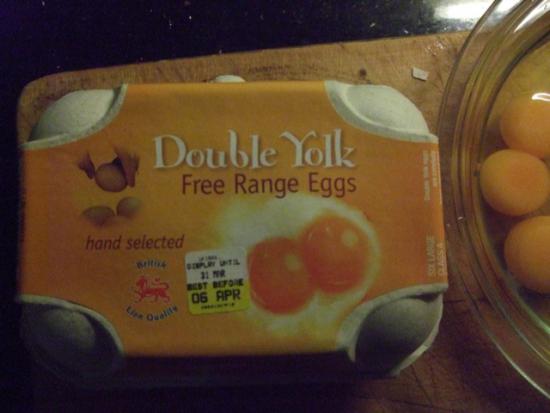
Not a one-in-a-trillion chance
This idiotic example has a serious point. All calculations of probabilities of events are contingent, in that they are dependent on assumptions. And if those assumptions are wrong, then the edifice can collapse. So how much probability should we retain to cover all the eventualities we never thoght of? This is the essence of Cromwell's Law, which we have already discussed in detail.
- david's blog
- Log in to post comments
