Submitted by david on Sun, 07/08/2016 - 11:35am
What words are appropriate when describing the unavoidable unpredictability of real life – what we might casually call ‘chance’?
Submitted by david on Tue, 28/06/2016 - 2:06pm
Submitted by david on Wed, 08/06/2016 - 3:45pm
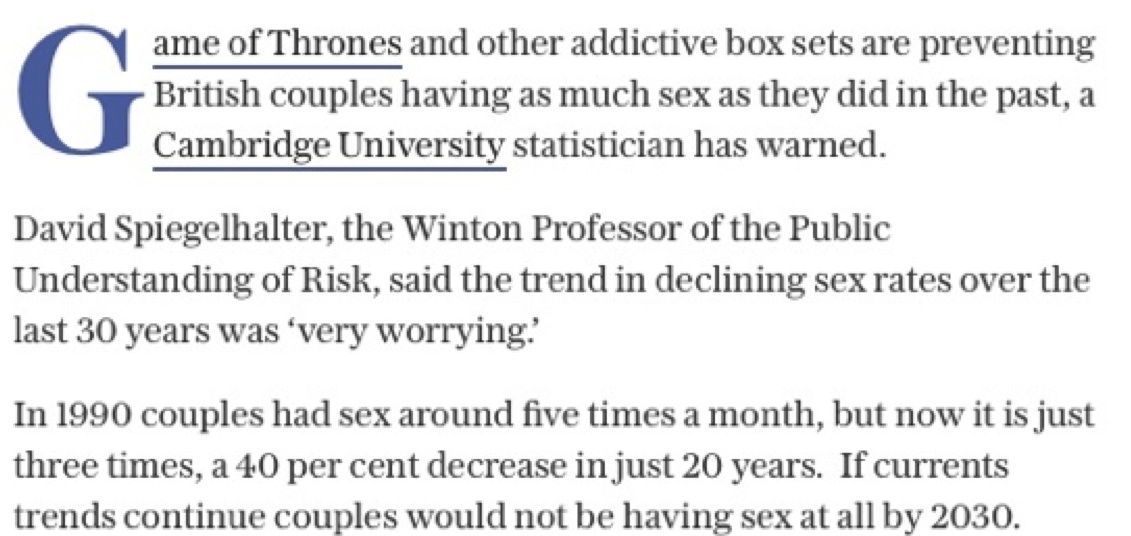
I’ve had a lot of publicity over the last few days, but none of it was welcome. It arose from the story below from the Daily Telegraph of June 6 with the headline “Britons are having less sex, and Game of Thrones could be to blame, says Cambridge professor”
Submitted by david on Sun, 22/05/2016 - 11:29am
Remember all those autism stories over the last few weeks? You don’t? There’s a reason for that.
Submitted by david on Sat, 09/01/2016 - 11:55am
Yesterday the Chief Medical Officer announced new guidelines for alcohol consumption. The Summary says,
The proposed guidelines and the expert group report that underpins them, have been developed on the basis of the following principles:
Submitted by david on Sat, 21/11/2015 - 4:09am
On Thursday November 19th the printed version of the Guardian had the headline “Experts dispute Hunt's claim on weekend hospital treatment“ [online version here]. But it was not only Health Secretary Jeremy Hunt who gave a misleading statement – the Guardian also made a serious error about statistics.
Submitted by david on Sat, 14/11/2015 - 11:22am
The way that risks are 'framed' can make a big impression on their apparent magnitude. The controversy following the recent report by NICE on hormone replacement therapy (HRT) provides a fine example.
Submitted by david on Sat, 17/10/2015 - 12:16pm
Surgeons are increasingly subject to statistical monitoring, and named results may be made publicly available. But consider a surgeon in a low-risk specialty who has had a successful and blameless career, until a combination of circumstances, possibly beyond their control, contribute to a single patient dying. They then find they are officially labeled as an ‘outlier’ and subject to formal investigation, all because of a purely statistical criterion. Is this fair?
Submitted by david on Sun, 17/05/2015 - 9:16pm
I like doing live interviews for radio or TV – it’s exciting and they can’t edit what you say. The programme is almost inevitably running late, so last Saturday morning when I did an interview for Radio 4’s Today I remembered my media training and had prepared carefully to get my points over before they cut me off.
Submitted by david on Wed, 13/05/2015 - 5:47pm
There has been much wailing and gnashing of blogs since the dismal performance of the pre-election polls last week. These had confidently and consistently predicted a rough tie in vote-share between Labour and Conservative, but when the votes were counted the Conservatives had a 6.5% lead.
Comparison of vote-share BBC Poll of polls on May 6th, and actual results on May 7th.
Pages

